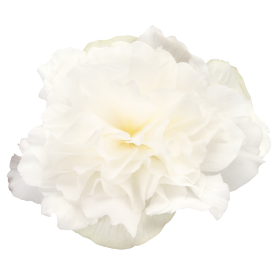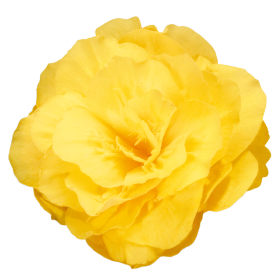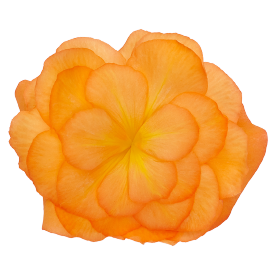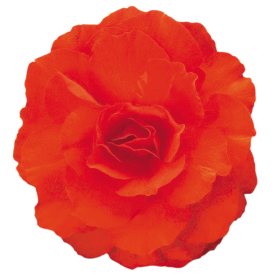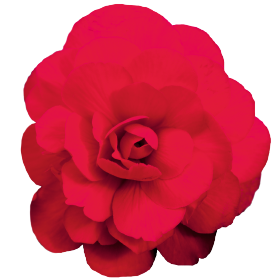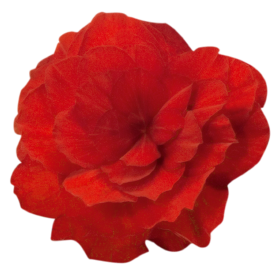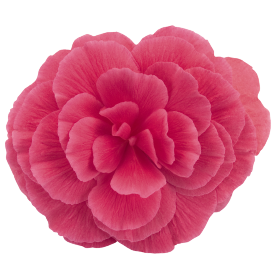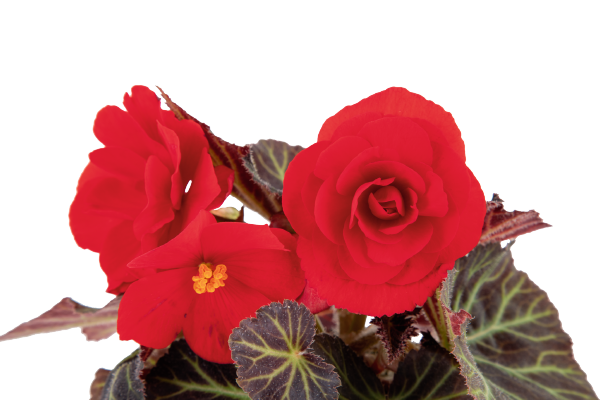
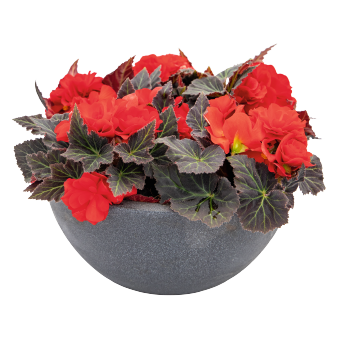
Nonstop® Mocca Deep Red
Item no.: BT0505PUnique - the Only Dark Leaved Tuberous Begonia Series on the Market
- Full, compact and rounded plant habit
- Uniform and strong branching plants
- Excellent outdoor performance
- Highest transplantable seedlings in the industry
- Free flowering of large double flowers
- Comprehensive color assortment
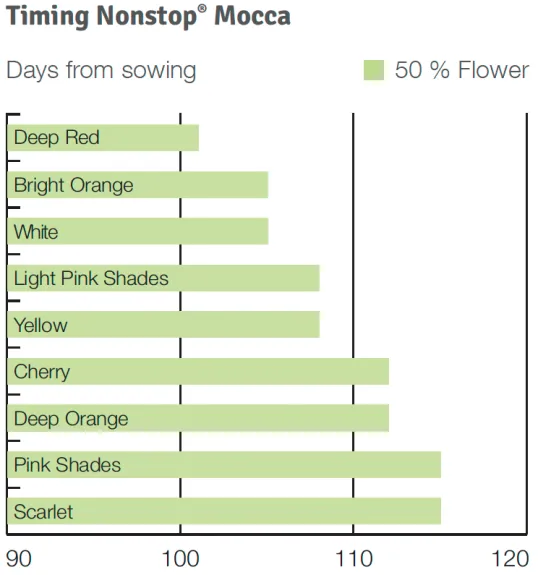
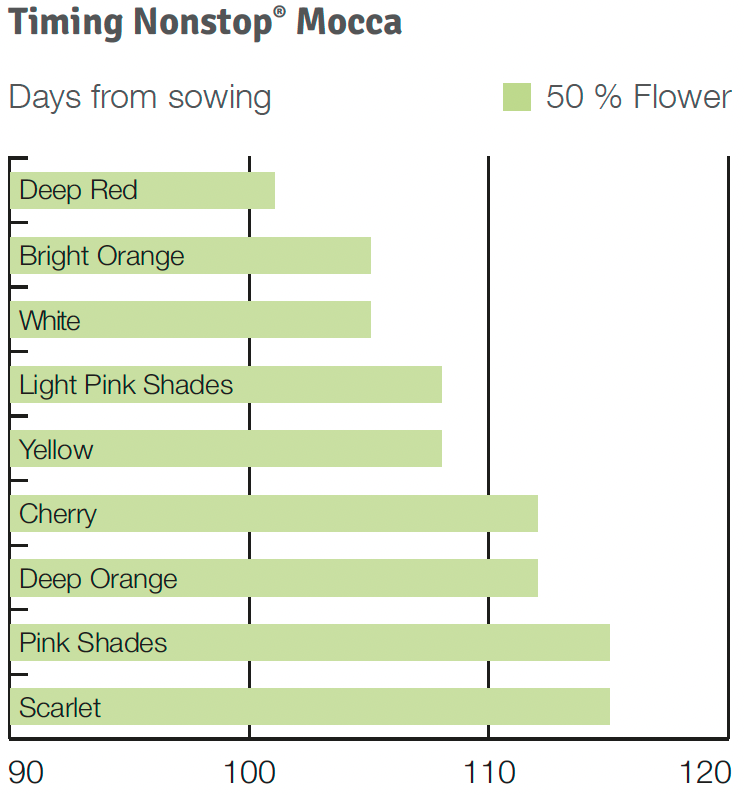
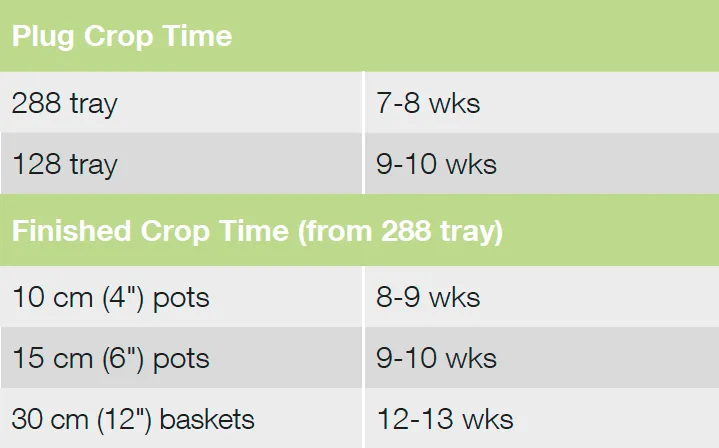
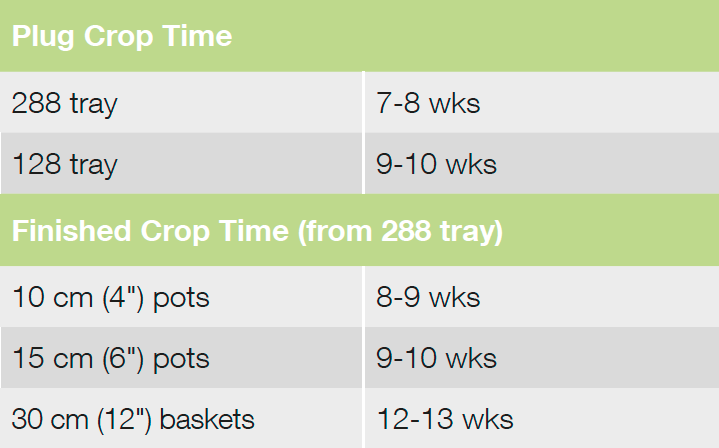
- Crop Time
- Spring: 15 - 18 weeks
- Height ∅
- 10 ″ / 25 cm
- Width ∅
- 9 ″ / 23 cm
- Exposure
- Partial shade - Shade
- Seed Form
- Pelleted Seed
- Product Use
- Pots, Hanging Baskets, Mixed Containers, Landscape
- Family, Origin
- Begoniaceae, South and Central America
- Minimum Germ. Rate
- 85%
Technical Guide
Flowering Type: Obligate long day plant requiring a day length > 13.5 hrs. to initiate flowering. A night break can also be used, lighting for 5 hrs. during the night from 10 pm-3 am.
Flowering Mechanism: Tuberous begonias are light accumulators. Day length extension and supplemental lighting will hasten flowering and improve plant quality.
Germination: Maintain optimal conditions for seedling development should begin on the day of sowing until root emergence. Expect root emergence in 7-10 days.
Cover: No covering of the seed is required.
Sowing method: Sow 1-2 seeds or pellets per plug.
Media: pH 5.5-5.8; EC 0.5 Begonia are sensitive to high salt levels.
Temperature: Maintain 22-23 °C (72-73 °F) until roots emerge. Higher temperatures, exceeding 27 °C (80 °F) will inhibit germination. Upon root emergence, on day 10-14 reduce the temperature to 20‑21 °C (68‑70 °F) until cotyledon expansion. On day 21 the temperature can be reduced further to 20 °C (68 °F). For irrigation use warm water (above 18 °C/64 °F) only.
Moisture: Begin with a media moisture level of saturated (5) from day 1‑11. A saturated media and high humidity is critical to successful begonia germination. Beginning on day 12, alternate between moisture levels wet (4) and moist (3). Allow the media to approach a moist (3) before re‑saturating to a wet (4). On day 21 the seedlings need to begin a good wet to dry cycle to aid ooting and avoid algae formation. Once germinated the seedlings are sensitive to watering with too much pressure and water volume since they have just begun to root into the media. It is easy to dislodge the seedlings resulting in a lower number of usable plants. Use a fine nozzle or water breaker with a gentle pressure and low water volume.
Humidity: Maintain 95‑100 % humidity until day 11 then dehumidify and reduce to 60 %. Provide proper ventilation and horizontal airflow to improve oxygen levels in the media.
Light: Light is necessary for germination and benefit the germination process and improve quality. If utilizing a germination chamber, providing a light source of 10‑100 ft. candles (100‑1,000 lx) will improve germination and reduce stretch. Provide long days of 14‑16 hrs. to improve germination and overall seedling quality.
Fertilizer: Begin fertilizing early, once germination is complete, approximately day 14. Lower rates of feeding at 50 ppm 2‑3 times per week will help to size up the seedlings. Under higher light conditions use a 17‑5‑17 fertilizer and under lower light a 14‑4‑14.
Plug Bulking and Flower Initiation: Maintain optimal conditions during the vegetative stage from cotyledon expansion to flower initiation. When the seedling root to the edge of the plug and reach the 4-6 true leaf stage flower initiation will occur.
Media: Use a well-drained, growing substrate; pH 5.5-5.8; EC 1.25-1.5
Light: Long days of 14-16 hrs. are required to keep plants from producing tubers and to initiate flowering. Light levels of 8-10 mol/m2/ day (25,000-30,000 lx) will improve quality and hasten flowering. Only moderate levels of light are required to keep plants vegetative. A minimum of 10-15 ft. candles (550 lx) is all that is required to avoid tuber formation, however-higher light will benefit overall quality. Supplemental lighting under low light conditions providing 350-600 ft. candles (3,500-6,000 lx) will improve quality. Shading is required when light levels reach 3,500-4,000 ft. candles to prevent leaf edge burn.
Temperature: Maintaining the ideal temperature will achieve the shortest crop time. On days 28-42 keep the temperature at 20-21 °C (68-70 °F). A slightly lower temperature of 19-20 °C (66-68 °F) will reduce stretch in the seedlings. Tuberous begonias are very responsive to DIF where a 1-2 °C (34-36 °F) DIF will also keep plants compact. Once roots have reached the bottom of the tray after day 42 the temperature can be lowered to 18-19 °C (64-66 °F).
Moisture: Use care to make sure that the media is not kept saturated and is allowed to dry back between waterings. Alternate between moisture levels wet (4) and moist (3). Allow media to approach level (3) before re-saturating to level (4). Avoid allowing the media to become too dry since begonias are sensitive to high salts and root damage can occur.
Fertilizer: Alternate between a calcium based fertilizer (14-4-14 or 15-5-15) and an ammonium based fertilizer (17-5-17) at 50-100 ppm nitrogen every 2-3 waterings. Fertilizer applications can be gradually increased in the later stages of bulking where a constant feeding at 100 ppm is used. Under high light and long days an ammonium based fertilizer (20-10-20) at 50-100 ppm can also be used.
Growth Regulators: Very low rates of Cycocel (chlormequat chloride) as a spray at 250 ppm (0.04 %.) can be used. B-Nine (daminozide) sprays at 500-750 ppm can also be made. Applications are usually made once established in the final container, however, if a larger plug (72 tray) is being grown they may need one application of Cycocel or B-Nine before transplanting.
Fungicides: Apply preventative sprays for botrytis, pythium and rhizoctonia as needed.
Media: Use a well-drained, growing substrate; pH 5.5-5.8; EC 1.0-1.5.
Light: Continue with long days of 14-16 hrs. Until the day length is > 12 hrs. or mid-March. Provide 10-12 mol/m2/day (30,000-35,000 lx) for optimum quality. If plants are placed under short day conditions growth will become uneven. Day length extension is very important to continue vegetative growth. If light levels exceed 4,000 ft. candles provide shading to reduce the leaf temperature. Under high light conditions provide shading to prevent leaf edge burn.
Temperature: After transplanting maintain 18-20 °C (64-68 °F) nights for the first 14 days or until the roots reach the bottom of the container. Thereafter temperatures may be lowered to 16-18 °C ( 60-64 °F). An ADT (average daily temperature) of 19 °C ( 66 °F) will give the fastest finished crop. Temperatures below 14 °C (57 °F)will result in tuber formation and a delay of the crop. A DIF of 1-2 °C (34-36 °F) will result in a more compact crop requiring little to no growth regulators.
Moisture: Alternate between moisture levels wet (4) and medium (2). Allow plants to approach a medium (2) before re-saturating to a wet (4). Allowing plants to dry back too much can result in root damage.
Humidity: 40-60 % humidity is ideal. Providing good ventilation and horizontal airflow will help lower the humidity and dry back the media, providing oxygen to the roots.
Fertilizer: Alternate between calcium based fertilizer 14-4-14 and an ammonium fertilizer 17-5-17 at 100-150 ppm. Keep the media EC at 1.5. Application of potassium nitrate can help to keep the plants more compact. Under higher light and warmer temperatures a fertilizer with additional ammonium can be used. Tall, stretched plants with few flowers indicate too much ammonium. Stunted, chlorotic plants with marginal leaf burn indicate a lack of calcium and magnesium. Under high light and extended day length an ammonium-based feed (20-10-20) at 100-150 ppm nitrogen can also be used.
Growth Regulators: If needed, Cycocel (chlormequat chloride) can be made as a spray two weeks after transplanting at 300-500 ppm (0.04 %). Cycocel will not hasten flowering, but will increase the number of flowers. A negative DIF of 1-2 °C (34-36 °F) is also very effective in height control. If using DIF then additional PGR’s should not be necessary.
Fungicide: Apply fungicides during long periods of low light and high humidity.
Common Diseases: Botrytis, pythium, rhizoctonia, powdery mildew and tomato spotted wilt virus.
Pests: Primarily aphids and thrips.
Post Harvest: Fertilize with potassium nitrate at 100 ppm 1-2 weeks prior to shipping. Lowering the temperature to 16 °C (60 °F) will help to tone the plants before shipping.
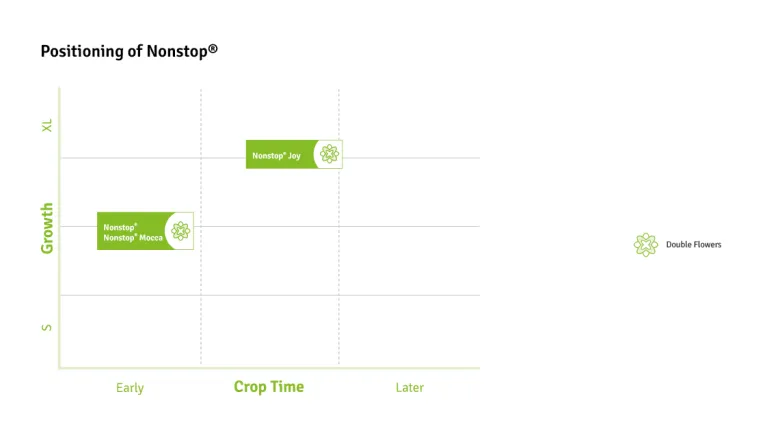
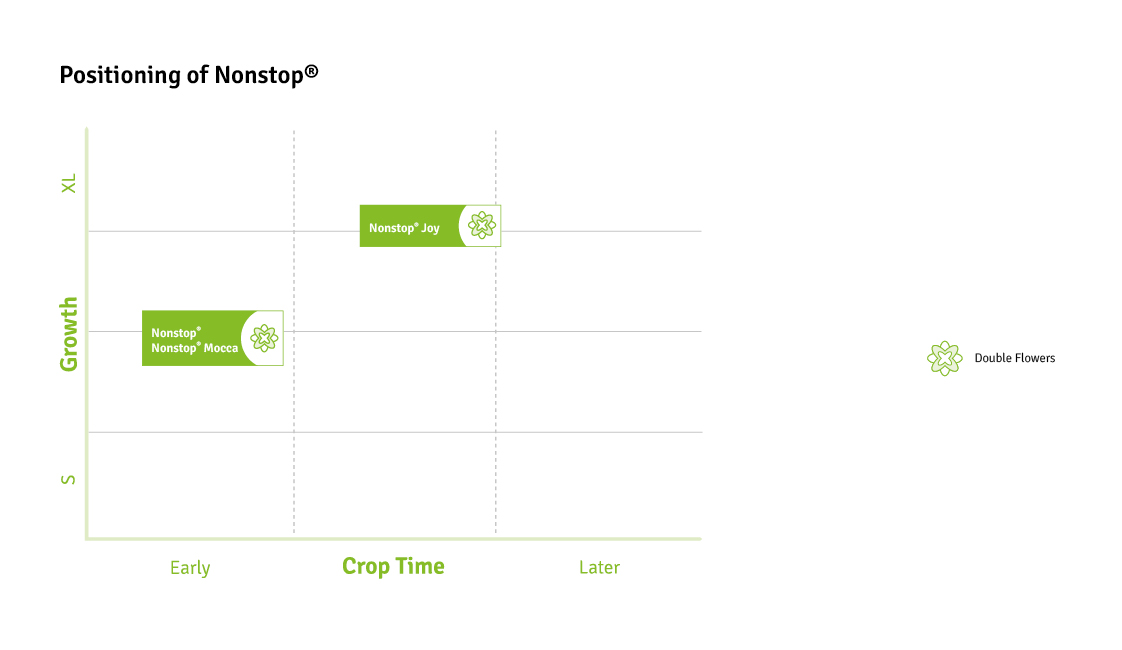
Expert Tip
Spacing the plants will increase overall plant quality. Do not cultivate too wet since the roots are sensitive to over-watering. Keep humidity levels low to avoid problems with powdery mildew. When transplanting with multiple plants in a pot or basket make sure that the points of the leaves face outward since this is the direction that the flowers will be produced heaviest.
Moisture Codes
| Saturated (5) | Water is easily observed when finger is pressed on cell. Water moves freely from the top of the plug to the bottom. |
| Wet (4) | Media looks black and is not glistening. The media feels wet to the touch but there is very little water movement. |
| Moist (3) | Water is not easily visible. When finger is pressed on the cell there is very little movement from top to bottom. |
| Medium (2) | Media is not black, but now looks medium brown. There is no water movement when pressed with finger. |
| Dry (1) | Media has changed color to a very light brown and is dry to the touch. |
All information in our technical guide is based on our own trials and would therefore be as guideline only. Detailed cultivation aspects vary depending on climate, location, time of year and environmental conditions. Benary expressly disclaims any responsibility for the content of such data/information and makes no representation or warranty for the cultivation of any products listed. It is recommended that growers conduct a trial of products under their own conditions.