
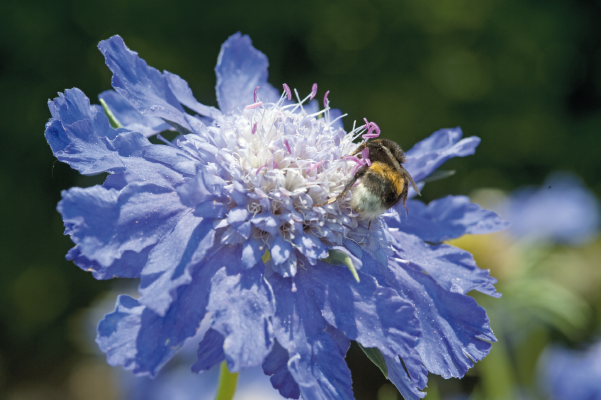

Fama® Deep Blue
Item no.: SC0101R/C- FastraX perennial: first year flowering without vernalization
- Huge, delicate blooms
- Great use as cut flower
- High number of flower stems the first year

- Crop Time
- Spring: 18 - 22 weeks
- Height ∅
- 22 ″ / 55 cm
- Exposure
- Sun - Partial shade
- Seed Form
- Raw Seed, BeGreen Coating
- Heat Zone
- 8-5
- Hardiness Zone
- 4-8
- Product Use
- Bedding, Landscape, Cutflower
- Family, Origin
- Caprifoliaceae, Caucasus region
- Minimum Germ. Rate
- 75 %
Technical Guide
Flowering Type: FastraX perennial – first year flowering plant without vernalization. Day neutral plant, will flower regardless of the day length.
Flowering Mechanism: High light intensity and warmer temperatures shorten the total crop time.
Germination: Optimum conditions for seedling development, beginning on the day of sowing until radicle emergence. Expect radicle emergence in 10-14 days.
Cover: Light is required for germination, cover the seeds only lightly with vermiculte.
Sowing method: 1-2 seeds per plug
Media: pH 5.8-6.2; EC 0.5-0.75
Temperature: 18-20 °C (64-68 °F) for the first two weeks. Once cotyledons have expanded, the temperature can be lowered to 16-18 °C (60-64 °F).
Moisture: Begin with a wet (4) media for germination. After 10 days, reduce to moisture level moist (3) and then further to medium (2) until transplanting. A rather dry cultivation is recommended.
Humidity: 95-100% until radicle emergence, then reduce to 40-60%. Provide proper ventiliation and horizontal airflow to improve oxygen levels in the media.
Light: After radicle emergence, provide 2,000-2,500 ft. candles (20,000-25,000 lx). Later, the light level can be increased up to 4,000-5,000 ft. candles (40,000-50,000 lx). The plants should be hardened before transplanting to tolerate the full sun outside.
Fertilizer: Maintain an EC <1.2. Begin fertilizing early to improve seedling quality. Initial feeding should start at 50-100 ppm and gradually work up to 100-175 ppm during plug production. Use a complete balanced fertilizer.
Plug Bulking and Flower Initiation: Maintain optimal conditions during the vegetative stage from cotyledon expansion to flower initiation. Vernalization is not required.
Growth Regulators: For cut flower usage, no growth regulators should be used. For transplanting as cut flower, 45 plants/m² are recommended. For the first harvest, 5-10 stems per plant can be expected, but 10-20 stems for the second harvest. Do not plant the plugs too deep.
Media: pH 5.5-6.0; EC 1.0-1.3
Light: Once transplanted into the field or greenhouse, additional light is no longer possible. Long days are not required for flowering. High light intensity and warmer temperatures shorten the total crop time.
Temperature: For spring sowings, ensure 12-15 °C (54-59 °F) during day and night after transplanting, as lower temperatures can cause premature flowering and poor performance. For overwintering indoors, ensure frost-free conditions at least at 3-5 °C (37-41 °F) and low humidity. The plants can be forced for flowering with increasing temperatures: Maintain 12-15 °C (54-59 °F) for 10 to 12 weeks or 16-18 °C (61-64 °F) for 6 weeks.
Moisture: Scabiosa do not like to stay wet, so avoid overwatering. If irrigation is possible, allow the media to dry back before re-saturating.
Fertilizer: Moderate fertilization levels are required. Fertilize the plants weekly with 100-150 ppm N using a complete balanced fertilizer. Prevent magnesium and iron deficiency. During forcing in spring, fertilize 150-200 ppm N using a potassium balanced fertilizer.
Growth Regulators: For cut flower usage, no growth regulators are required.
Fungicides: Apply fungicides during long periods of low light, cool temperatures and high humidity.
Common Diseases: Botrytris, downy mildew, root rot.
Pests: Aphids, mites.
Harvest: Harvest the stems once 50% of the florets have opened. Harvested buds will not open later. Three harvest cycles per planting can be expected.
Post Harvest: Include an ethylene-inhibiting product to avoid flower shattering and decay. Hydrate the stems immediately after cutting and store them in a cooler at 1-3 °C (34-38 °F) until usage.
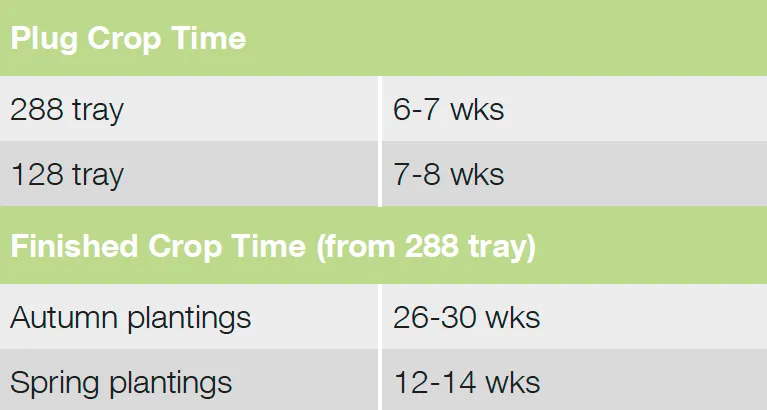
Plug Crop Time
288 tray: 6-7 weeks
128 tray: 7-8 weeks
Finished Crop Time (from 288 tray)
Autumn plantings: 26-30 weeks
Spring plantings: 12-14 weeks
Expert Tip
“Fama®” is tested as cut flower to ensure excellent flower and stem quality, reliable stem yield per variety, and long vase life. Cultivation is suitable in greenhouses, tunnels or open fields for cut flower usage. Sowing takes place from January to March for flowering in summer, or from June to August for overwintering with flowering the following spring. Cold treatment (vernalization) is not required.
Moisture Codes
| Saturated (5) | Water is easily observed when finger is pressed on cell. Water moves freely from the top of the plug to the bottom. |
| Wet (4) | Media looks black and is not glistening. The media feels wet to the touch but there is very little water movement. |
| Moist (3) | Water is not easily visible. When finger is pressed on the cell there is very little movement from top to bottom. |
| Medium (2) | Media is not black, but now looks medium brown. There is no water movement when pressed with finger. |
| Dry (1) | Media has changed color to a very light brown and is dry to the touch. |
All information in our technical guide is based on our own trials and would therefore be as guideline only. Detailed cultivation aspects vary depending on climate, location, time of year and environmental conditions. Benary expressly disclaims any responsibility for the content of such data/information and makes no representation or warranty for the cultivation of any products listed. It is recommended that growers conduct a trial of products under their own conditions.