
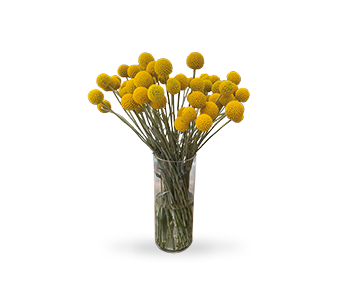
SolarPop
Item no.: CG0201R- Large, golden flower heads
- Trendy highlight in every flower bouquet
- Attracts many beneficial insects
- Suitable for pots, containers and the landscape
- Crop Time
- Spring: 12 - 14 weeks
- Height ∅
- 26 ″ / 65 cm
- Width ∅
- 14 ″ / 35 cm
- Exposure
- Sun - Partial shade
- Seed Form
- Raw Seed
- Product Use
- Pots, Containers, Landscape, Cutflower
- Family, Origin
- Asteraceae, Australia & New Zealand
- Minimum Germ. Rate
- 85%
Technical Guide
Flowering Type: Facultative long day plant. A day length > 12 hours will result in flower initiation.
Flowering Mechanism: Flowering is affected by day-length, irradiance and temperature. High light intensity and warm temperatures shorten the total crop time. Cooler temperatures after transplanting improve the uniformity of flowering.
Germination: Optimum conditions for seedling development, beginning on the day of sowing until radicle emergence. Expect radicle emergence in 4-7 days.
Cover: Cover the seed with vermiculite or substrate after sowing.
Sowing method: 3 seeds per plug.
Media: pH 5.8-6.2; EC 0.5-0.7.
Temperature: 20-22 °C (68-72 °F) on days 1-7. For irrigation use warm water (above 18 °C/ 64 °F) only.
Moisture: Begin with a wet (4) for the first 7 days. Then, a moist (3) is optimum for the seedlings. Good ventilation and horizontal airflow will always help.
Humidity: 95-100 % until day 7; then reduce to 40-60 %.
Light: Protect the seedlings from direct sunlight until they are well established.
Media: pH 5.8-6.2; EC 0.7-1.2
Temperature: 18-20 °C (64-68 °F) during night and day. When the roots reach the bottom of the cell, the temperature can be lowered to 14-16 °C (57-60 °F). Cooler temperatures promote uniformaty and compactness of the plugs.
Fertilizer: Begin fertilizing early to improve seedling quality. When the plants are well established, maintain an EC of 0.7-1.2 by using a balanced fertilizer.
Growth Regulators: No growth regulators are required in the plug stage. Growth can be controlled by temperature and moisture management.
Media: pH 5.8-6.2; EC 0.7-1.2.
Light: High light levels reduce the overall crop time and promote early flowering.
Temperature: 14-16 °C (57-60 °F) days, 12-14 °C (54-57 °F) nights for two weeks after transplanting. After that, temperatures can be reduced by 2 °C (36 °F) day and night. Cooler temperatures promote stable flower stems and a compact, well-branched plant habit in pots. A frost-free outdoor production is also possible. The minimum temperature at night is 5 °C (40 °F) as Craspedia does not tolerate frost.
Moisture: Alternate between moisture levels moist (3) and medium (2). Let plants dry back before re-saturating. Avoid overwatering.
Humidity: 40-60 % humidity is ideal. Providing good ventilation and horizontal airflow will help lower the humidity and dry back the media, providing oxygen to the roots.
Fertilizer: Craspedia is a medium feeder. Use a balanced fertilizer (15-5-15) with an EC of 0,7-1,2.
Growth Regulators: With proper moisture and temperature management, there should not be a need for growth regulators. Approximately two weeks after transplanting, when plants are established in the final container, a very light application of Dazide can be applied. For cut flower production, no growth regulators are required at all. Pinch the first floral stem to induce more stems to develop. For pot production, pinching is not necessary.
Fungicide: Apply fungicides preventive during wet periods of high humidity and low light levels.
Common Diseases: Fusarium, botrytis.
Pests: Primarily aphids.
Post Harvest: For cut flower production, the stems are ready to be harvested when 20-30 % of the flower are showing color. Store in clear water or water treated with a floral preservative solution. The stems will have to be recut later.
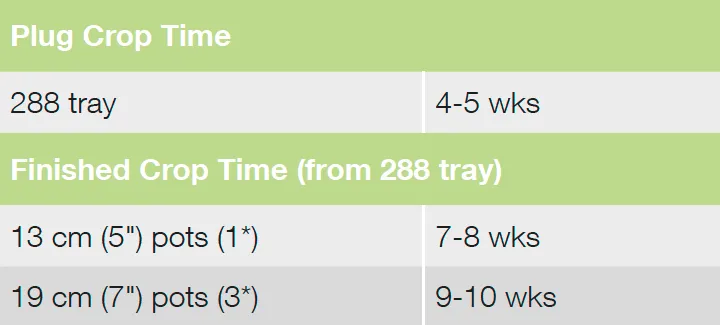
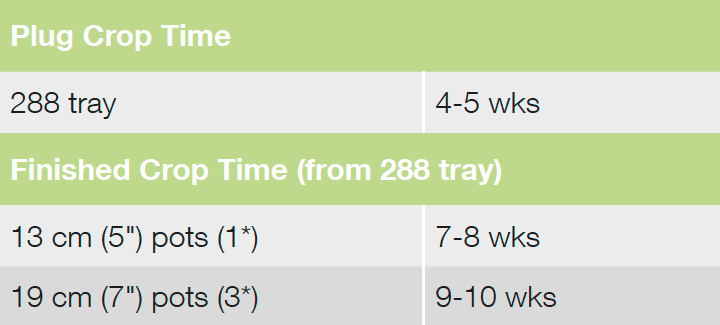
Expert Tip
“SolarPop” can be used as pot and container plant, for landscape planting as well as for cut flower usage, fresh and dried. The plants deliver an excellent flower and stem quality with a long vase life. This alternative to vegetative varieties impresses with significantly better branching, faster growth and more intense silvery leaves.
Moisture Codes
| Saturated (5) | Water is easily observed when finger is pressed on cell. Water moves freely from the top of the plug to the bottom. |
| Wet (4) | Media looks black and is not glistening. The media feels wet to the touch but there is very little water movement. |
| Moist (3) | Water is not easily visible. When finger is pressed on the cell there is very little movement from top to bottom. |
| Medium (2) | Media is not black, but now looks medium brown. There is no water movement when pressed with finger. |
| Dry (1) | Media has changed color to a very light brown and is dry to the touch. |
All information in our technical guide is based on our own trials and would therefore be as guideline only. Detailed cultivation aspects vary depending on climate, location, time of year and environmental conditions. Benary expressly disclaims any responsibility for the content of such data/information and makes no representation or warranty for the cultivation of any products listed. It is recommended that growers conduct a trial of products under their own conditions.